

Pretty references are not a plan. Visual strategy turns inspiration into direction.
Moodboards are useful.
They help gather inspiration. They create a visual starting point. They can reveal taste, energy, texture, color, and atmosphere before a design system exists.
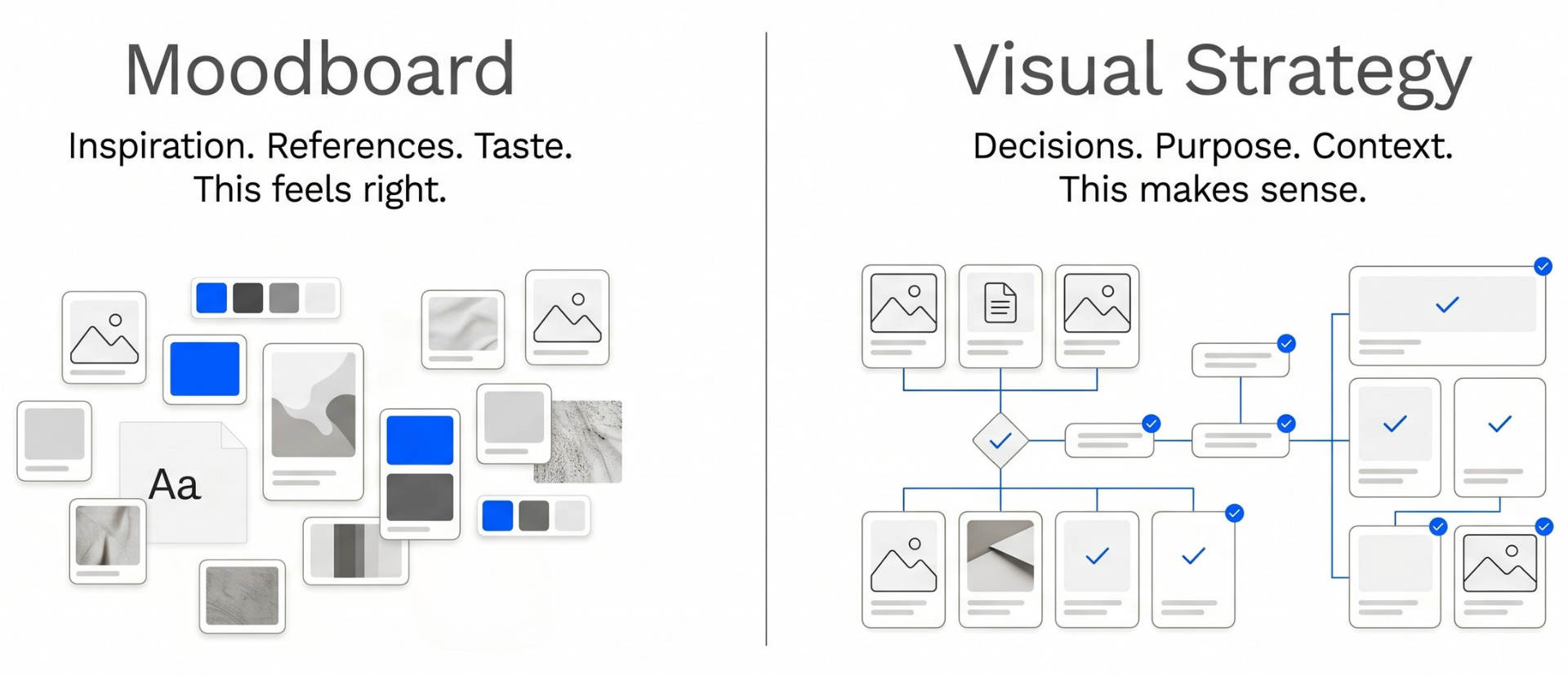
But a moodboard is not a visual strategy.
It is a collection of references.
A visual strategy is a set of decisions.
That difference matters because many brands confuse inspiration with direction. They gather images, save color palettes, pin typography samples, and assume they are building a visual identity. But what they often have is not a strategy. It is an aesthetic cloud.
It may feel aligned.
It may look beautiful.
It may even capture the right emotion.
But unless it answers what the brand should express, why that expression matters, and how visual choices should support the larger brand foundation, it is not doing the work of strategy.
It is only showing what the brand might look like.
Inspiration creates possibility. Strategy creates constraint.
A moodboard opens the field.
That is its value.
It gives people a way to see possible directions before anything is finalized. It helps translate abstract language into visual cues. Words like refined, bold, warm, modern, expressive, editorial, approachable, or premium become easier to understand when they are paired with imagery.
But possibility is not the same as clarity.
A visual strategy narrows the field.
It decides what belongs and what does not. It connects the brand’s purpose, audience, personality, voice, positioning, and emotional tone to the way the brand should begin to appear in the world.
That is where the real work starts.
A moodboard might say: this feels right. A visual strategy keeps asking. Right for whom, and for what message? Right in what context, compared to what alternatives, for the brand actually being built — not the aesthetic someone happens to love this week?
Without those questions, visual decisions become personal preference dressed up as strategy.
Aesthetic alignment is not enough
A brand can look beautiful and still be unclear.
It can have elegant colors, polished typography, thoughtful photography, and still fail to communicate the right idea.
That happens when the visual layer is built apart from the strategic foundation.
Design is not just about making something attractive. It is about making meaning visible. Every visual decision carries a signal. Color affects perception. Type affects tone. Layout affects confidence. Photography affects emotional access. Spacing affects sophistication. Contrast affects urgency. Composition affects trust.
When those choices are made only from inspiration, the brand may feel assembled.
When they are made from strategy, the brand starts to feel intentional.
That is the difference between a look and a system.
A look may work for one post, one homepage, or one campaign.
A system can stretch.
It can guide new pages, new campaigns, new content formats, new offers, and new creative decisions without starting over each time.
Design is not just about making something attractive. It is about making meaning visible.
Visual strategy gives design something to solve
A strong visual strategy does not replace the designer.
It gives the designer better material to work from.
This is an important distinction.
A designer’s job is not simply to “make it pretty.” A good designer interprets, prioritizes, builds hierarchy, creates rhythm, manages contrast, shapes perception, and translates abstract strategy into usable visual form.
That work cannot be fully handled by a moodboard.
A moodboard can show references.
A designer turns direction into decisions.
They decide how the brand should behave visually across real contexts. How should the homepage feel before anyone reads a word? What should the brand signal in the first three seconds, and where should the eye go first? How much restraint does the brand need, and when should the system feel expressive instead of quiet? What gets repeated so the brand becomes recognizable — and what gets avoided so it does not drift?
These are not decoration questions.
They are brand questions expressed through design.
High-level direction is not finished design
This is also where tools need to be honest about what they provide.
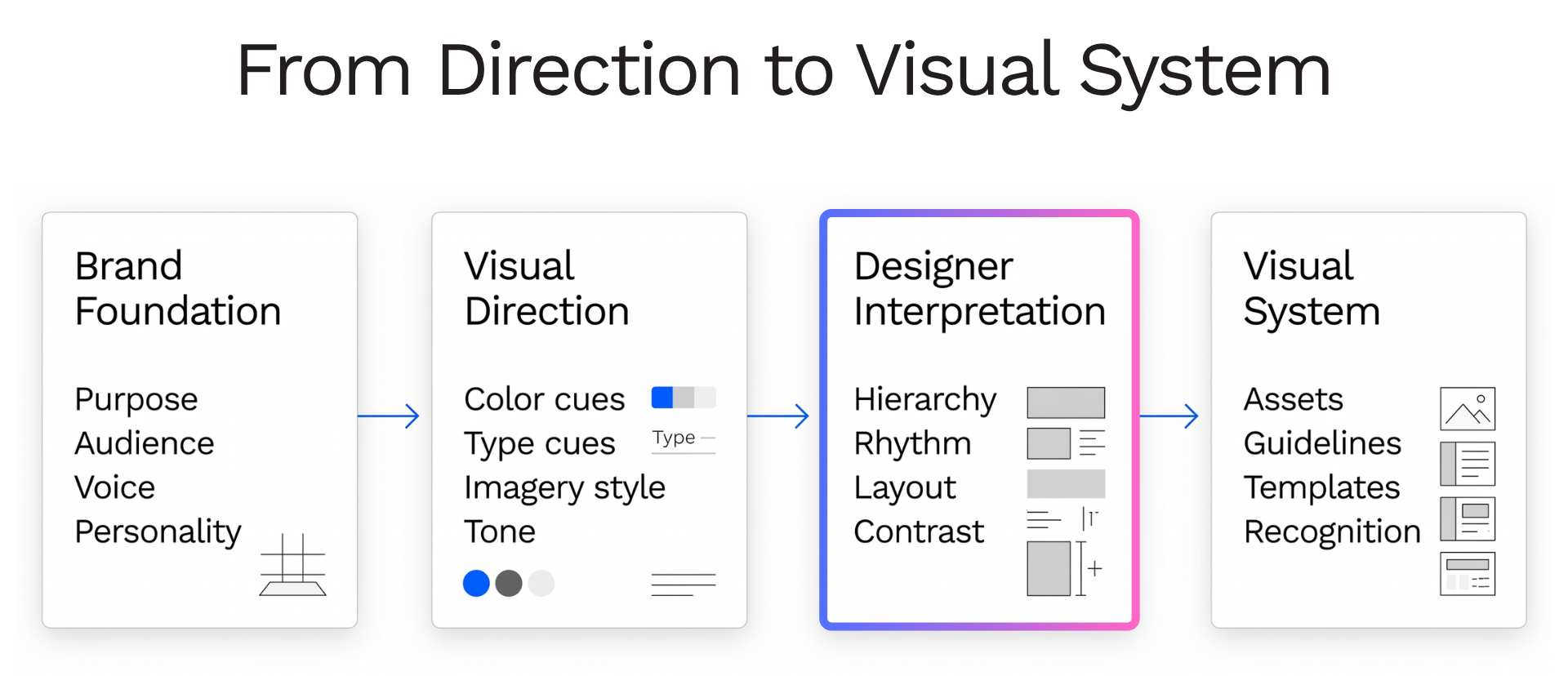
EpiphanySuite’s Brand Blueprint includes high-level visual direction. It can help define color, typography cues, imagery style, and overall visual tone based on the brand foundation a user has built.
That direction is valuable.
It gives the user and designer a clearer starting point. It helps prevent random visual choices. It connects the visual layer to the brand’s purpose, audience, voice, and personality before design begins.
But it is not a finished identity system, a full logo suite, or a complete set of brand guidelines. And it is not a substitute for the judgment of a designer.
The Blueprint gives direction.
A designer brings that direction to life.
That is how it should work.
The role of visual direction is to reduce guesswork before creative execution begins. It gives the designer a stronger brief. It gives the founder or team a better way to evaluate creative work. It gives everyone a shared reference point before opinions take over.
Instead of starting with “I like this” or “Can you make it pop?” the conversation can start with:
This is what the brand needs to communicate.
That changes the quality of the design process.
Moodboards show taste. Strategy shows intent.
Taste matters.
Taste helps a brand feel distinct. It shapes the sensibility of the visual world. It can create emotional pull.
But taste alone is unstable.
It changes with trends. It reacts to what competitors are doing. It gets influenced by what is popular on Pinterest, Instagram, Canva, Behance, or whatever someone saw that week.
Intent is steadier.
Intent asks what the brand is here to do, what it needs people to understand, and how it wants to be perceived over time.
That is why visual strategy has to sit between brand foundation and design execution.
It creates a bridge.
Not a shortcut.
A founder may not need to know how to design a full brand system. But they do need enough clarity to recognize whether the design is moving in the right direction.
A designer may not need every answer handed to them. But they do need a strong strategic foundation so they are not forced to invent the brand visually from scratch.
A moodboard can support that process.
It just cannot carry the whole thing.
The real risk is visual drift
When there is no visual strategy, brands drift.
One post looks minimal. The next looks playful. One landing page feels premium. The next feels generic. The typography shifts. The imagery shifts. The tone shifts.
Nothing is technically wrong.
But nothing is building recognition.
That is the hidden cost of treating moodboards as strategy. They can create excitement at the beginning, but they do not always create consistency over time.
Visual strategy protects against that.
It gives future creative decisions a point of reference. It helps teams understand what to repeat, what to refine, and what to reject. It makes visual consistency easier because the logic behind the look is clear.
Not rigid.
Clear.
A strong brand system still has room to evolve. But it evolves from a center.
Without that center, every new asset becomes another chance to reinvent the brand.
The point is not to skip design. It is to start design better.
The future of brand building is not about removing designers from the process.
It is about making the process less scattered before design begins.
Too many founders and small teams jump straight into visuals without knowing what those visuals need to express. They choose colors before they clarify personality. They pick fonts before they understand tone. They collect inspiration before they define the message.
That is how brands become attractive but inconsistent. Polished but generic. Creative but disconnected. A better process starts earlier.
Decide the brand before you design it.
Then use visual direction to guide the work.
And next, let a designer do what designers do best: translate strategy into form, feeling, hierarchy, and recognition.
A moodboard can inspire the work.
Visual strategy gives it meaning.
A designer makes that meaning real.
Skip the middle, and what looks like a brand is just a mood.
Want to build a brand foundation that makes visual direction easier? EpiphanySuite was made for exactly that. Start for free.