

The tools are ready. But is the foundation?
AI has made brand consistency an operational problem. When anyone can generate on-brand output in seconds, the system either holds or it doesn’t. The industry has responded with infrastructure. What it hasn’t asked is what the infrastructure is carrying.
The answer the industry has landed on is governance. Lock the system. Embed the brand into the tools. Build infrastructure that makes consistency the default rather than something a creative team enforces after the fact. That answer is right. But it stops one step short.
A system can only carry what was decided before it was built.
Brand infrastructure — templates, governance layers, AI-assisted content tools — is designed to protect and extend something. The assumption is that the something already exists. That the brand knows who it is for, what it stands for, how it should sound, what it should signal, and what it should refuse.
For most brands, those decisions were never cleanly made. They were implied. Inherited. Assembled from early executions that hardened into habit. The brand launched, the work started, and the foundational questions got deferred because there was always something more urgent.
A brand system built on deferred decisions doesn’t solve the problem. It scales it.
The guidelines existed. The foundation didn’t.
The industry has spent years diagnosing brand inconsistency as an execution problem. Teams aren’t following the guidelines. Designers are going off-brand. The tone keeps shifting. The visuals don’t feel cohesive.
The prescribed solution is always operational: better guidelines, more templates, stronger governance, faster review cycles.
But when you follow the inconsistency back to its source, you rarely find a team that ignored the system. You find a system that was built before the brand knew what it was. Voice guidelines written before anyone decided what the brand actually believed. Visual systems assembled before the brand understood what it needed to signal. Naming conventions established before the audience was truly understood.
The system was sound. The foundation beneath it wasn’t ready to be carried.
AI makes undecided brands visible faster.
Generative AI has changed the stakes of this problem. When content production was slow, undecided foundations produced inconsistency gradually — a misaligned campaign here, a tone shift there. Brand drift was a slow leak.
AI turns that leak into a flood. When every team member can generate content in seconds, the gaps in the foundation surface immediately and at scale. Not because AI is careless — because AI is precise. It follows the system exactly as written. When the system has gaps, AI fills them with its best interpretation of your category, not your brand.
The result is content that is technically consistent and strategically hollow. It uses the right colors. It follows the templates. It sounds like a brand — just not a particular one.
That’s not an infrastructure failure. That’s the Brand Decision Gap made visible at speed.
Distinctiveness cannot be templated. It has to be decided.
Consistency is becoming a commodity. AI makes it achievable for every brand simultaneously. A locked system keeps a brand from drifting. It does nothing to keep it from blending in.
Distinctiveness — the quality that makes a brand recognizable before the logo appears, memorable after the ad disappears, harder to replace when a competitor offers something similar — cannot be added to a system after the fact.
What does the brand stand for that a competitor could not credibly claim? What does it sound like when it has something difficult to say? What does it refuse, even when refusal is commercially inconvenient? What does it signal to the right audience that the wrong audience might misread?
These are not design questions. They are foundational decisions. And they have to be made before the first template is built, before the first governance layer is written, before the first AI prompt is trained on your brand voice.
The next era of brand leadership starts upstream.
The conversation about brand infrastructure is right about where the problem shows up. It is solving for the wrong starting point.
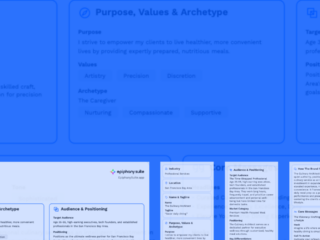
The brands that will hold in an AI-accelerated market will need more than sophisticated governance systems. They will need decision systems beneath them: a clear way to make, connect, document, and carry foundational brand choices before the work scales.
Governance can protect the brand once decisions exist. Decision systems make those decisions clear enough to protect.
The Brand Decision Gap often gets treated as a governance or design issue, but it usually starts earlier: in the clarity layer upstream of every system, tool, and template the industry is currently building toward.
Brand infrastructure is the outcome. Brand decisions are the foundation. Before you design the system, you have to decide what it is built to carry.
Decide before you design. That’s not just a design principle. It’s a business one.
EpiphanySuite helps you decide the foundation before the work starts to scale — so your brand systems, content, and creative direction have something clear to carry. Start for free.