

Design doesn’t begin with inspiration.
It begins with translation.
Strategy and design are often treated like adjacent rooms with a door between them. Walk out of one, walk into the other. But nothing hands off automatically, and the door most brands imagine simply isn’t there. Somewhere in that space, brand strategy is supposed to turn into design direction—and when it doesn’t, no amount of design skill on the other side can make up for it.
That space deserves a name.
The Brand Translation Layer
Most organizations recognize the work. Few recognize it as a distinct layer.
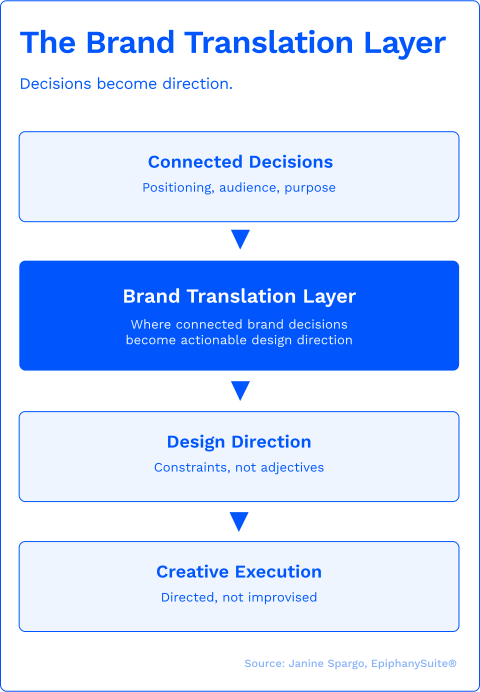
I call it the Brand Translation Layer: the operational layer where connected brand decisions are translated into actionable design direction before creative execution begins.
It isn’t another round of strategy. The positioning, audience, and purpose work are already finished by the time a brand reaches this point. It isn’t design yet either—nothing here touches a typeface or a color palette. Its only job is translation: it takes a connected set of brand decisions and turns them into direction a designer can actually build from.
Skip this layer and design work still happens. It just happens without instructions. One designer improvises from a moodboard. Another guesses at tone from the last campaign. A third defaults to whatever looks contemporary this year. None of them are wrong, exactly. They’re each answering a question nobody actually asked them to answer, which is why the output reads like a brand with several different authors.
It is one.
What Moves Through the Layer
A functioning Brand Translation Layer carries specific information, not vague sentiment. It translates decisions about who the brand is for, what it stands for, how it should be perceived, what messages deserve emphasis, how it should sound, and what emotional response the work is meant to create.
These aren’t values on a wall. They’re constraints a design team can be held to.
There’s a real difference between telling someone to “make it feel premium” and giving them a specific, brand-particular answer to what premium means here—the difference between a mood and a decision. Constraints make design decidable instead of debatable.
Creative constraints don’t dictate every decision. They make certain decisions obvious, others impossible, and still leave room for craft.
A designer who knows the constraint can defend a choice. A designer working from a feeling can only have an opinion.
Two brands can hand a designer the identical brief—clean, modern, trustworthy—and need entirely different work in return because “trustworthy” means something different to a fintech startup than it does to a family-owned funeral home.
Without a decision that defines which version of trustworthy this brand means, the designer has to invent one.
Multiply that across every project, every campaign, and every new creative hire, and the brand accumulates as many definitions of trustworthy as it has people interpreting it.
Where the Trail Runs Cold
This is where most brands go looking for the wrong culprit.
A brand starts to feel inconsistent. One campaign feels confident, the next unsure of itself. A rebrand three years later looks like a different company took over. The instinct is to blame the designer, the agency, the creative director, or the latest tool. Sometimes that’s fair.
More often, the design team was never given a thread to hold. They were handed a strategy deck and asked to interpret it, which means every output reflects one person’s reading of the brand rather than a shared set of decisions about what the brand is.
The inconsistency was never a design failure.
It’s what happens when the Brand Translation Layer never existed, and the work downstream had nothing concrete to execute against.
Why Faster Tools Don’t Close the Gap
AI has made this easier to miss, not harder.
Governance frameworks, brand kits, design systems, and style guides encoded into software all move faster now, and speed can look like progress.
But infrastructure without decisions beneath it doesn’t close the gap. It automates the guessing.
A brand kit can enforce a hex code across a hundred assets in the time it used to take a person to update ten, and it will enforce that hex code just as faithfully whether or not anyone ever decided what the brand actually means.
Scale multiplies whatever already exists—alignment or misalignment, on schedule either way.
This is the part that’s easy to miss from inside a fast-moving organization.
Consistency and alignment look like the same achievement from the outside because both produce assets that match.
But consistency only checks whether outputs resemble each other.
Alignment checks whether they resemble a decision.
A brand can be perfectly consistent and still be consistently wrong, repeating the same undefined guess across every channel instead of correcting it once at the source.
Why This Changes the Conversation
This is the piece that reorganizes everything that came before it.
Brand foundation work only earns its keep if something downstream is built to receive it.
That’s what the Brand Translation Layer does.
Without it, foundation stays theoretical—a document instead of a working part of the organization.
Expression only stays coherent if it’s drawing from the same source every time design happens, and that source has to pass through this layer before it reaches a designer’s hands.
Every argument about decisions preceding design has been pointing toward this layer.
It simply hadn’t been named.
Where Design Really Fails
A brand doesn’t fail at the moodboard.
It fails one step earlier, in a layer nobody acknowledged, where a decision was supposed to become direction and never did.
Build the Brand Translation Layer. Fill it with real decisions instead of adjectives.
Once it exists, the design work downstream stops being interpretation and starts becoming execution of something specific enough to get right—and specific enough to know, immediately, when it’s been gotten wrong.
Before a brand can be expressed consistently, it must first be translated consistently.
Continue Reading
The Brand Decision Gap — Why most branding problems begin before design.
The Brand Decision Layer — How connected brand decisions create a shared foundation.
From Foundation to Expression — Why consistent expression depends on a consistent source.

About the Author
Janine Spargo is an award-winning brand and creative strategist, and the founder of EpiphanySuite®. With more than 25 years of experience serving small businesses and global enterprises, she helps founders, creators, and organizations articulate purpose, define voice, create visuals, and build enduring brands.