


Why AI is making structured brand decisions more valuable than ever.
Over the past year, a noticeable pattern has emerged across the branding and AI landscape.
Creative platforms are investing in brand intelligence. Enterprise platforms are building persistent knowledge systems. Marketing leaders are talking less about whether to adopt AI and more about how to make AI effective, trusted, and operational at scale.
These are different companies solving different problems.
Yet they appear to be responding to the same underlying shift.
I don’t believe these are isolated product announcements.
I believe they are early signals of a broader structural change in branding.
AI Has Become Infrastructure
The conversation has moved beyond whether AI belongs in creative and marketing work.
Canva’s The State of Marketing and AI Report 2026, conducted with The Harris Poll, found that 97% of marketing leaders now use AI in their daily creative work, while 99% expect AI investment to increase in 2026. The global study surveyed 1,415 marketing leaders at organizations with 500 or more employees and 3,547 consumers across seven countries.
AI is no longer an experiment sitting outside the creative process. It is becoming part of how campaigns are developed, content is produced, and marketing work gets done.
That changes the question.
It is no longer simply:
Should we use AI?
It is becoming:
What does AI need to know about our brand to produce consistently good work?
Greater Capacity Is Exposing a Different Problem
Generative AI is already increasing the speed and volume of creative production.
Adobe’s 2026 AI and Digital Trends Report, a global survey of 3,000 executives and practitioners conducted with Oxford Economics, found that 76% of organizations reported moderate to significant improvements in the speed and volume of content ideation and production through generative AI. Sixty-nine percent reported gains in employee productivity, while 65% reported improvements in marketing-driven revenue.
Those are meaningful gains.
But greater production capacity introduces a corresponding challenge.
In separate research, Canva found that 94% of marketers are concerned about maintaining brand consistency as AI use grows.
Generation is solved. Whether that content reflects a clear, recognizable, and strategically coherent brand is not.
The Market Is Responding
This helps explain why leading platforms are expanding beyond content generation.
Canva is investing in technology that helps organizations create on-brand content at scale.
Adobe recently introduced Brand Intelligence, a system designed to transform brand guidelines, approved assets, campaign performance, and reviewer feedback into structured knowledge that AI agents can use throughout creative workflows.
Across the industry, we’re seeing growing investment in:
• brand intelligence
• persistent brand context
• knowledge systems
• governance
• connected creative workflows
• AI-aware brand infrastructure
These initiatives differ in implementation.
But they share a common objective:
Help people and intelligent systems work from the same understanding of the brand.
That is an important evolution.
But it also raises another question.
Where does that shared understanding come from?
Most Brand Systems Begin After the Decisions
Most brand technology assumes the foundational work has already been completed.
Brand kits organize approved assets.
Governance systems monitor consistency.
Knowledge repositories preserve information.
AI assistants retrieve existing guidance.
Brand intelligence systems learn from established brand knowledge.
These capabilities are valuable.
But they generally begin after an organization already understands its purpose, positioning, audience, messaging, personality, voice, and visual direction.
In reality, many organizations are still discovering those answers.
Others have documented them inconsistently.
Some have never connected them into a coherent system at all.
The result is familiar.
Teams interpret the brand differently.
Agencies reconstruct context from scratch.
Designers compensate for incomplete briefs.
AI produces outputs that may be technically accurate but strategically inconsistent.
When this happens, blame usually lands on the technology. The root cause sits upstream, in the decisions the technology has been given.
A Pattern Is Emerging
What I find most interesting is not any single announcement.
It is the convergence.
Canva is helping organizations apply brand knowledge more consistently.
Adobe is helping organizations operationalize that knowledge across AI-enabled workflows.
Other platforms are investing in governance, memory, and connected context.
Different companies are solving different problems.
Viewed together, however, they point toward the same conclusion.
As AI becomes more capable, the quality, structure, and accessibility of the underlying brand knowledge become increasingly important.
That leads to a question I believe the industry is only beginning to explore:
Where do clear, connected, and structured brand decisions come from in the first place?
The Brand Decision Layer
Before organizations can govern brand knowledge…
Before AI can consistently apply it…
Before creative systems can operationalize it…
Someone has to create it — not as isolated workshop outputs or disconnected statements scattered across presentations, briefs, and strategy documents, but as a connected system of decisions that can evolve together over time.
Purpose informs positioning.
Positioning shapes messaging.
Audience influences voice.
Voice influences expression.
A change in one decision often affects every decision that follows.
The relationships among these choices matter just as much as the individual decisions themselves.
I believe this upstream capability is becoming a distinct layer within the modern brand technology ecosystem.
I call it the Brand Decision Layer.
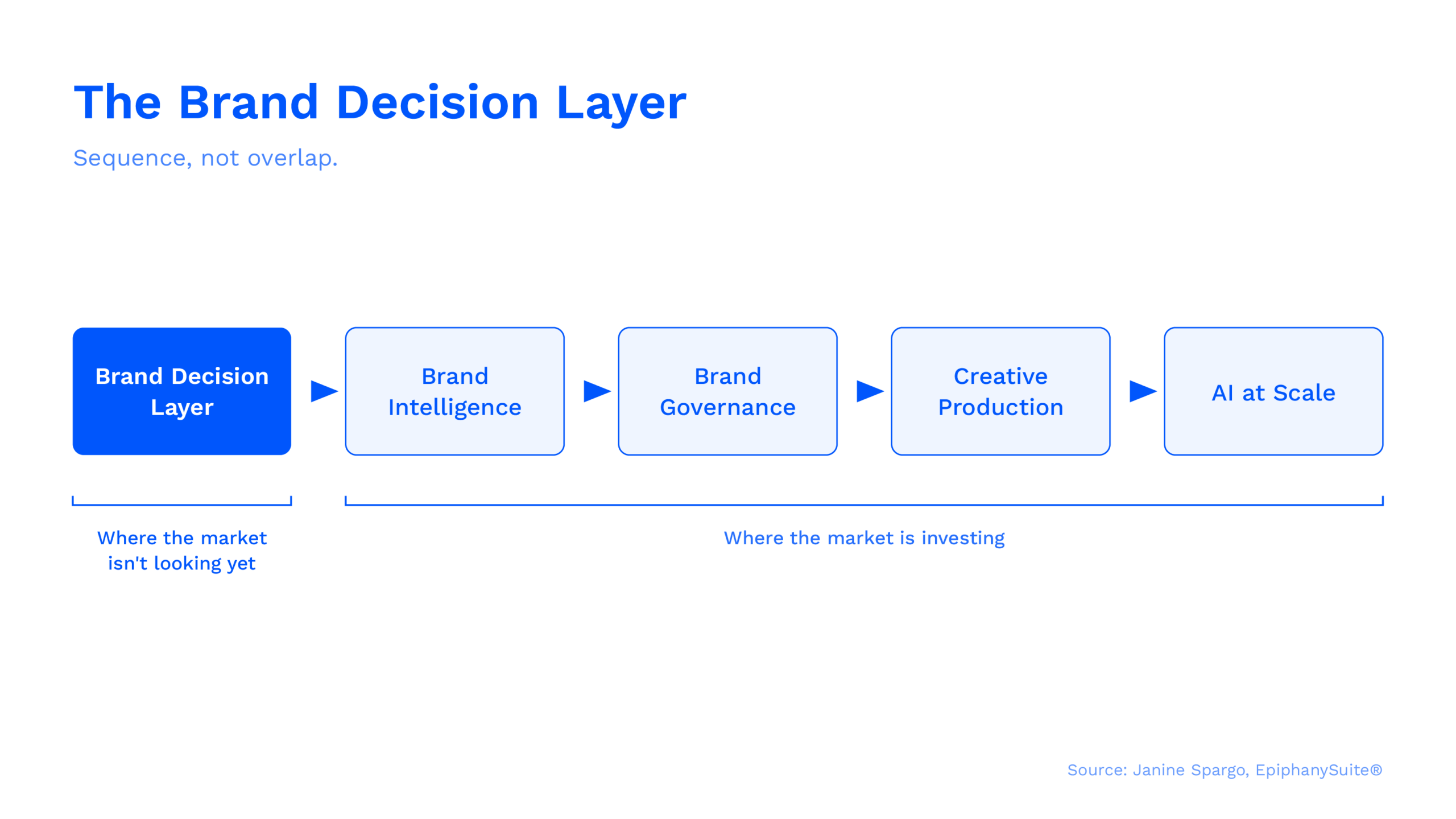
It is the layer where organizations transform insight into structured brand knowledge before that knowledge is governed, retrieved, scaled, and expressed.
Why This Matters
Five years ago, disconnected brand decisions primarily created inefficiency.
Today they create inconsistency across people, AI systems, channels, and experiences.
Tomorrow they may determine how effectively organizations can scale their brands through increasingly intelligent systems.
As AI becomes better at producing work, the quality of the underlying brand decisions becomes more visible — not because AI replaces strategy, but because it increasingly references, applies, and scales the choices people make.
The clearer and more connected those choices are, the more effectively both people and AI can build upon them.
The Next Question
The future of branding will not be defined by better content generation alone, nor by more sophisticated governance, nor by larger collections of approved assets.
The next competitive advantage may come from giving every person — and every intelligent system — access to the same connected understanding of what the brand is, what it stands for, whom it serves, and how it should behave.
That requires more than documents.
It requires decisions that are clear, connected, persistent, and usable.
The market is rapidly building better ways to apply brand intelligence.
The missing upstream question is how that intelligence is created.
The question is no longer whether AI belongs in branding.
The more important question is this:
Are our brand decisions ready for AI?
⸻
Sources
- Canva. The State of Marketing and AI Report 2026. Conducted with The Harris Poll.
- Canva. On-Brand AI research.
- Adobe. 2026 AI and Digital Trends Report. Conducted with Oxford Economics.
- Adobe. Adobe Brand Intelligence.

About the Author
Janine Spargo is an award-winning brand and creative strategist, and the founder of EpiphanySuite®. With more than 25 years of experience serving small businesses and global enterprises, she helps founders, creators, and organizations articulate purpose, define voice, create visuals, and build enduring brands.