


A brand cannot become more intelligent if every interaction starts from zero.
For years, brands have documented the things they want people to remember: logos, colors, typography, voice, positioning, messaging and the principles that guide how the brand should show up.
Those elements typically live in guidelines, portals, design systems, templates, shared drives and asset libraries so people can find and use them again.
But documentation and memory are not the same thing.
Documentation records what has been decided.
Memory keeps those decisions active.
That distinction matters more now because the number of systems creating on behalf of a brand is growing rapidly. AI is becoming part of writing, design, marketing, customer experience and creative production. Agents are beginning to move beyond isolated tasks and participate across workflows.
Every one of those environments depends on context.
Without it, the brand starts over.
Every New Prompt Shouldn’t Require a New Explanation
Think about how many AI interactions still begin with a condensed brand briefing.
Here is our company.
This is what we do.
Our audience looks like this.
The brand should sound like this.
These are the guidelines.
Avoid these phrases.
Use these instead.
Then someone on another team opens a different tool and rebuilds the same context from scratch.
The problem isn’t simply inefficient prompting. The deeper issue is that the knowledge defining the brand remains disconnected from the environments expected to apply it.
Brand systems are beginning to evolve in response. Voice, positioning, messaging, visual rules and other strategic inputs can increasingly be structured so machines can access them directly rather than depending entirely on static reference documents.
That’s an important shift.
Still, making brand information machine-readable solves only part of the problem.
Access to the current brand doesn’t necessarily provide an understanding of the choices that shaped it.
A Brand Is Made of Accumulated Choices
Brands don’t emerge from a single decision.
They take shape through a sequence of connected choices about purpose, audience, positioning, belief, voice, messaging and creative direction.
Each one establishes context for what follows.
Positioning affects the messages a brand emphasizes. Personality influences language and tone. Strategy guides creative direction. That direction shapes what eventually gets designed.
Over time, these choices become part of the organization’s institutional knowledge.
Yet much of that knowledge isn’t stored as knowledge at all.
Instead, it gets scattered across presentations, workshop notes, strategy documents, PDFs, email threads, Slack conversations, creative briefs and the memories of people who were in the room when important choices were made.
The final answer may survive while the reasoning behind it disappears.
A team can remember the direction without remembering why it made sense.
Guidelines Preserve Outputs. Memory Preserves Context.
Traditional brand guidelines remain useful. They give people a shared reference point and establish standards for expression.
But they are usually snapshots.
They capture the brand at a particular moment, after a larger set of strategic choices has already been made.
A richer form of brand memory can preserve the thinking underneath those standards.
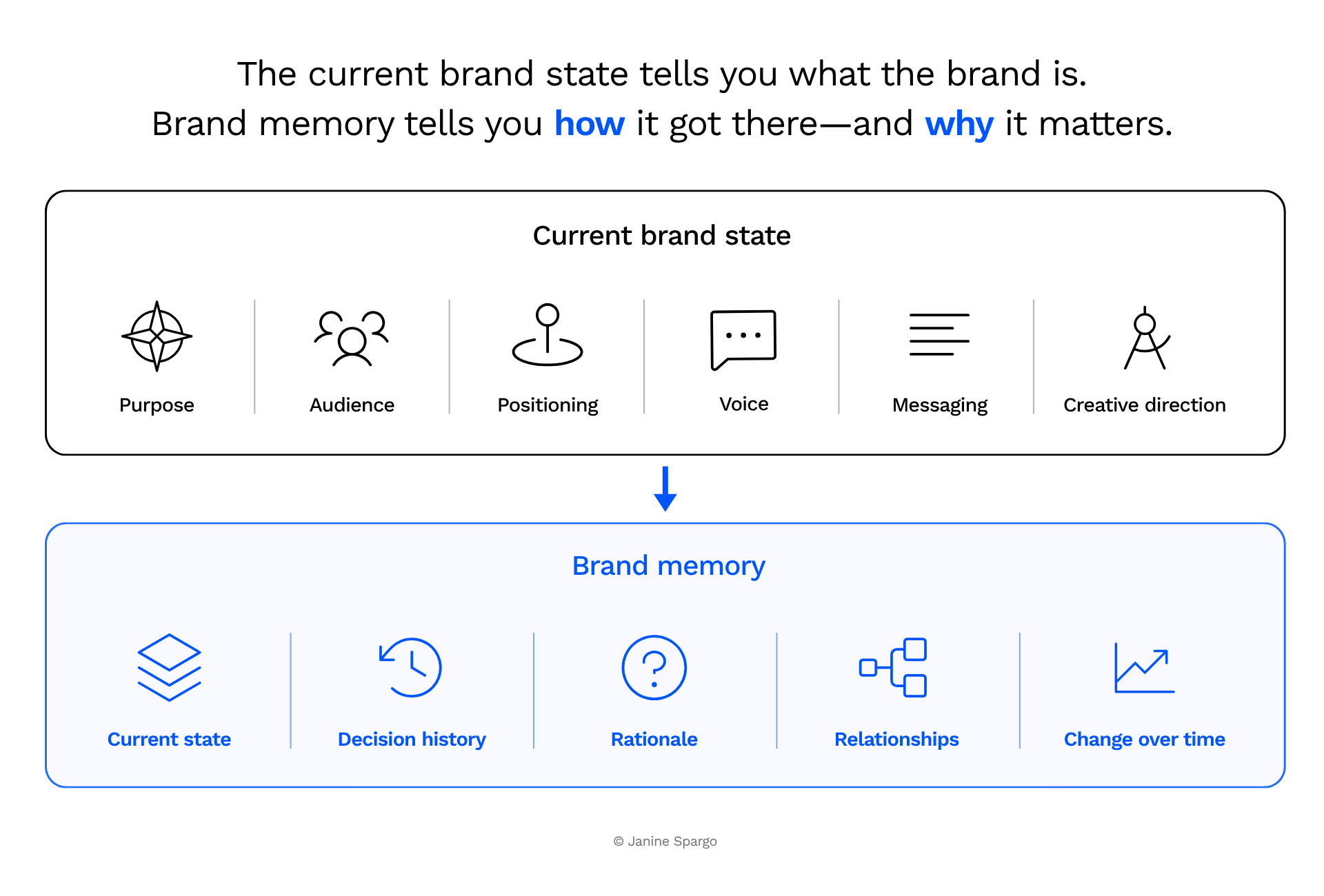
Purpose retains the organization’s reason for existing and the rationale that shaped it.
Audience knowledge captures who the brand serves, along with the needs, motivations and tensions that matter most.
Positioning preserves the competitive space the brand has chosen to occupy and the basis for that choice.
Voice defines the communication principles that guide how the brand speaks.
Messaging carries the ideas people should understand, believe and remember.
Creative direction translates strategy into the visual and experiential expression of the brand.
Making this knowledge persistent is an important step, but persistence alone isn’t intelligence.
A system may remember the current positioning, voice or audience and still know nothing about how those choices were reached. It can know the answer without understanding the history behind it.
Brand intelligence becomes more meaningful when memory includes not only the current state, but also the decisions, relationships and rationale that shaped it.
That introduces another important layer: decision history.
Markets move. Companies introduce new products. Audiences evolve. Leadership changes. Positioning gets refined. Messages become outdated. Creative systems expand.
A living brand shouldn’t simply replace one version of itself with another.
Its history should help explain how it got there.
From Source of Truth to Source of Context
For years, brand management has pursued the idea of a “single source of truth.”
That solves an important problem: fragmentation.
Teams need to know which logo is current, the correct color value, where the approved presentation template lives and which messaging document to use.
AI introduces an additional requirement.
Having the correct answer isn’t enough.
The context behind the answer matters, too.
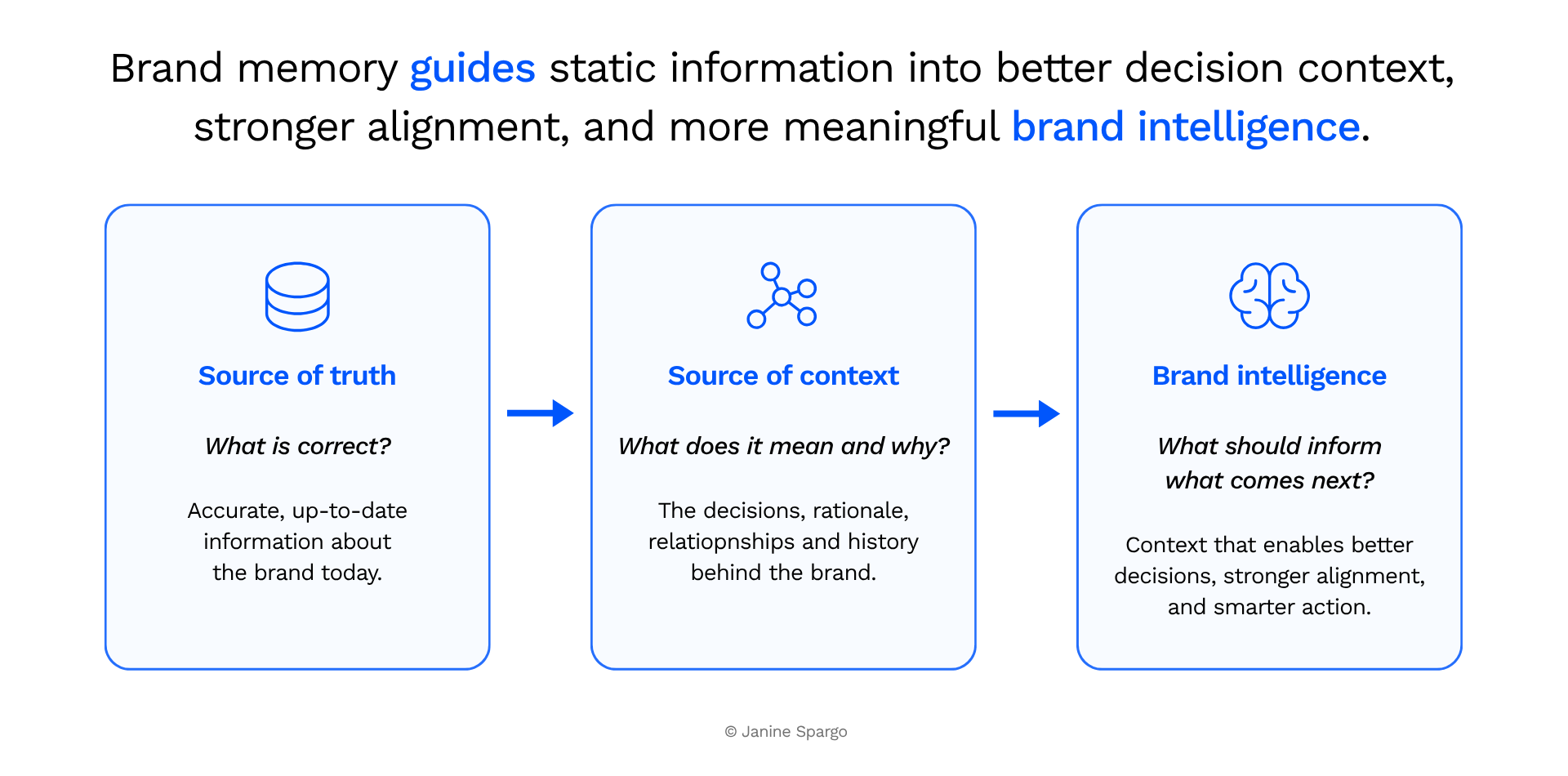
An approved tagline has limited value on its own. Connect it to the audience, positioning, message hierarchy, voice and strategic rationale behind it, and the system has something far more useful.
Context allows technology to move beyond retrieval and begin applying the thinking that shaped the brand.
That’s where brand infrastructure starts to look fundamentally different from a digital asset library or even a sophisticated brand portal.
The value no longer comes only from storing brand materials.
It comes from preserving the intelligence behind them.
Memory Makes Continuity Possible
Imagine the strategic foundation of a brand traveling with the work.
A writer enters a content environment with the appropriate voice and messaging already available.
Designers can access creative direction without searching for a separate presentation.
Marketing teams begin planning campaigns with audience, positioning and message hierarchy connected to the process.
AI agents reference the same underlying foundation when assisting with execution.
Different environments can then draw from a shared source of brand intelligence.
That creates continuity across people, tools and outputs without requiring every interaction to begin with another compressed version of the brand story.
None of this means machines should independently determine what the brand stands for.
As technology becomes more capable, the boundary between human judgment and machine application becomes increasingly important.
People establish, interpret and govern the foundation. Technology can help carry that context into the places where work gets done.
The goal isn’t to have AI reinvent the strategy every time someone needs an Instagram post.
It’s to stop making people reintroduce the strategy every time they ask for one.
Memory Allows Brand Knowledge to Compound
Once important brand choices are structured and retained, new information no longer has to exist in isolation.
An audience insight can sharpen positioning.
A shift in positioning may change the message hierarchy.
New messaging can influence content and campaign direction.
A strategic change might signal that parts of the visual system deserve reconsideration.
Each addition can build on what already exists rather than forcing the organization to reconstruct the brand again and again.
That’s when brand data begins to compound.
Its value grows through accumulated history, relationships and context.
Over time, this creates the possibility of something much richer than a repository of brand guidelines or a generator producing branded outputs.
Brand intelligence becomes a persistent layer connecting strategy, people and the growing number of tools working on the brand’s behalf.
The Next Generation of Brands Will Need to Remember
Creating things will continue to get easier.
Copy can be produced faster. Images can be generated in seconds. Concepts, presentations, campaigns and variations can multiply almost instantly.
That puts greater pressure on a different part of the process: making sure all of that creation comes from somewhere meaningful.
A prompt alone can’t provide that foundation.
Templates can support execution without holding the full strategic context.
Even a well-built brand book captures only part of the knowledge involved in shaping a brand over time.
Continuity demands something deeper: a foundation that can be understood, retained, updated and carried forward.
As our tools become more intelligent, the central question won’t simply be whether they can create for the brand.
It will be whether they have enough context to create from the brand.
A brand that wants continuity needs more than guidelines.
It needs a memory.
Continue Reading
The Brand Decision Layer — How connected brand decisions create a shared foundation.
The Brand Translation Layer — How connected brand decisions become actionable creative direction.
What Does It Mean to Compound Brand Data? — How connected brand knowledge becomes more valuable over time.

About the Author
Janine Spargo is an award-winning brand and creative strategist, and the founder of EpiphanySuite®. With more than 25 years of experience serving small businesses and global enterprises, she helps founders, creators, and organizations articulate purpose, define voice, create visuals, and build enduring brands.