
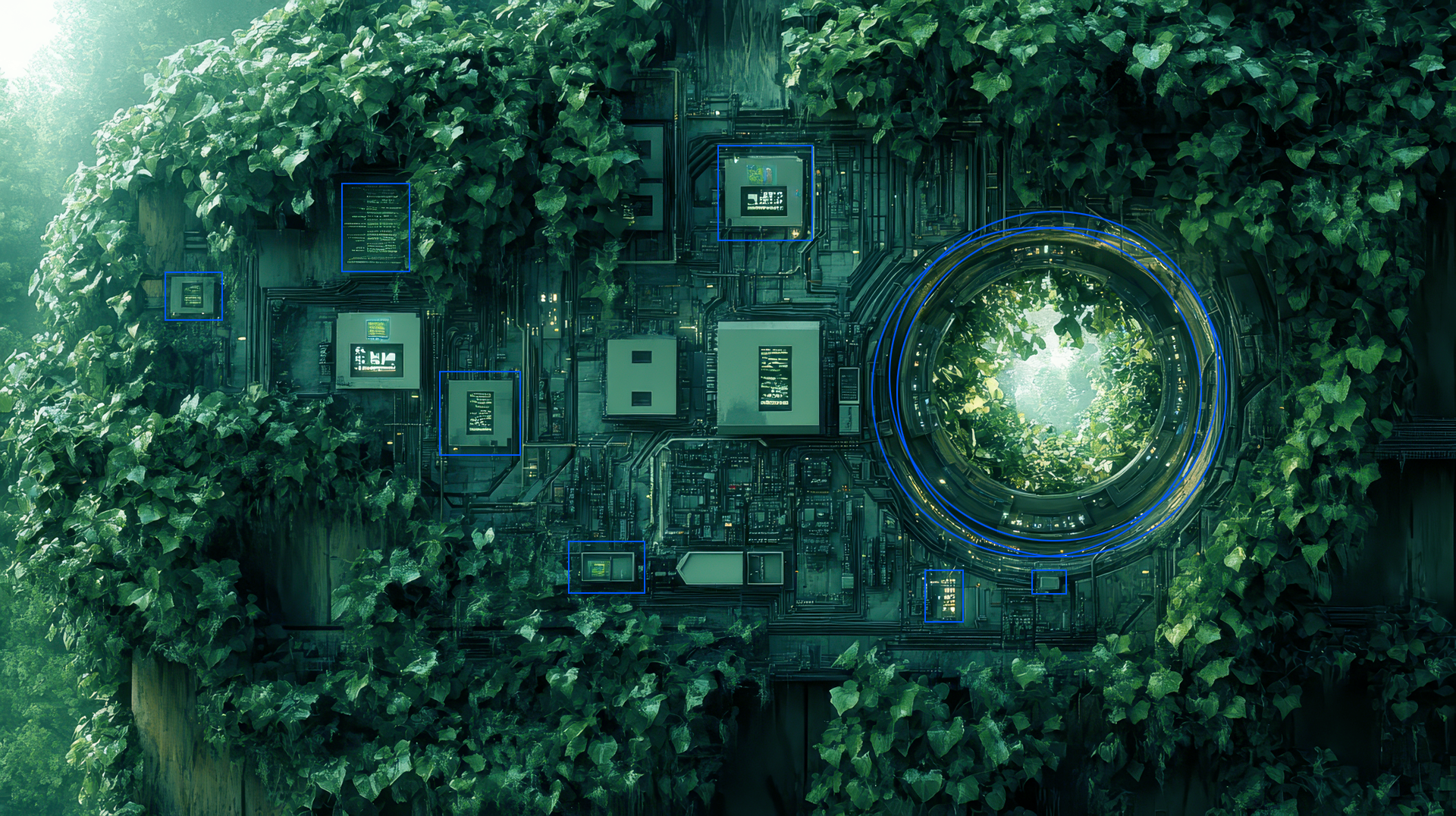
AI strips the ornament and exposes the foundation.
Editor’s note: This article continues a broader examination of how AI reshapes work, identity, and value. For more, read Work in an AI-Enabled Economy.
The loudest reactions to AI right now are emotional, not analytical. The outcry is consistent. Angry. Dismissive. Absolute. Declarations that sound defensive and territorial.
“AI is stealing writers’ jobs.”
“AI is replacing creatives.”
“AI is hollowing out human work.”
But blaming the machine is a misdiagnosis.
For decades, “creative” work was protected by a layer of performative complexity. Manual iterations. Layers of opinion. The “magic” of the process. AI hasn’t just automated the task; it has dissolved that buffer.
When the ornamental layers fall away, the structure underneath is finally visible. This is the source of the discomfort: a sudden, unasked-for clarity that reveals exactly where the value ends and the effort begins.
The question this moment forces is inescapable: once the effort is easy, what remains?
AI didn’t appear out of nowhere
One of the strangest narratives about AI is the idea that it is some singular “other” that arrived to compete with us. It didn’t. AI is built from us. From our writing, our research, our conversations, our documentation, our patterns of thought. And in quieter forms, it has been embedded in everyday software for decades. AI is not an external force so much as a compression of human output.
In that sense, AI is less an invader and more an advanced encyclopedia. One that doesn’t just store information, but recombines it at speed.
We didn’t revolt when encyclopedias made scholars more accessible. No protests when search engines replaced card catalogs. We accepted that access to knowledge could scale.
What has changed now is not the existence of knowledge, but its usability.
AI doesn’t just retrieve information. It operates on it.
That distinction matters.
No Theft of Expertise
No one accused encyclopedias of stealing expertise. They didn’t threaten identity. They centralized knowledge that already existed. People referenced it, built on it, and pushed their thinking further. Then the internet accelerated that shift by making access to information nearly universal.
AI takes that one step further. It doesn’t just retrieve. It recombines.
That recombination feels like creation, even when it isn’t originating ideas in the way humans do. And this is where fear enters.
If a system can produce something that looks like writing, design, strategy, or analysis, a painful question surfaces.
If this is easy now, what was I actually being paid for before?
That question isn’t about AI. It’s about the nature of the work itself.
Procedural work is being exposed
Much of the anger directed at AI is coming from fields where work quietly became procedural long before AI arrived.
Writing that followed templates.
Design driven by trends.
Strategy reduced to recycled frameworks.
These roles were already under pressure. AI simply made that pressure visible.
When people say AI is taking jobs, what they often mean is that AI is removing the protection once provided by opacity. When knowledge lived in scattered documents, tacit experience, and hard-to-transfer processes, those who controlled it held power.
AI collapses that distance.
It doesn’t eliminate value. It reveals where value actually lives.
“…AI is removing the protection once provided by opacity.”
What AI cannot do is still the point
AI can generate outputs. It cannot generate intent.
AI can synthesize language. It cannot decide why something matters.
It can reflect patterns. AI cannot take responsibility for meaning.
The most valuable work has never been about producing artifacts in isolation. It has always been about judgment. Choosing what to say, what not to say, what to prioritize, and what to stand behind.
Those decisions were often hidden behind deliverables. Now they are exposed.
That exposure is where the discomfort lives. Not because AI can think, but because it shows how often humans were not asked to. AI can assist, but it can’t supply intent.
The bitterness is a signal, not a solution
Anger at AI is understandable. It’s also unproductive.
Fear keeps people defending old roles instead of evolving into higher-value ones. It leads to gatekeeping, purity tests, and moral panic. None of that changes the trajectory of technology.
Every major shift in tooling follows the same arc. First disbelief. Outrage follows. Adoption lags. A new normal arrives.
The people who struggle most are not the least capable. They’re the most attached to being indispensable in outdated ways. It’s fear of losing the way they contribute, and the way they’re recognized for it.
This is not the end of creativity
The shift in value is real. Being “indispensable” now means setting direction and exercising judgment with AI in the loop, not performing every manual step.
Creativity isn’t the ability to produce something. It’s the ability to decide what should exist in the first place.
AI can help you write faster. It can’t tell you what’s worth writing.
AI can generate options. It can’t choose a direction and accept the consequences of that choice.
AI can accelerate execution. It can’t replace taste, restraint, or responsibility.
What it does remove is noise. Busywork. Performative complexity. The ornamental layers that once obscured weak thinking.
When that noise falls away, what remains becomes obvious.
We are confronting commoditization, not extinction
When people say AI is replacing writers or designers, what they’re really saying is that output alone is no longer enough.
That was already true.
Clients were never paying for words or visuals in isolation. They were paying for thinking. For confidence. For decisions they could trust. Over time, many industries forgot that distinction and mistook production for value.
AI didn’t create that confusion. It makes it impossible to ignore.
The work is moving upstream
The highest-value work now happens earlier. Before the prompt, the execution, and the artifact.
It lives in framing the problem correctly. Defining constraints. Setting intention. Understanding emotional and strategic context.
This is why AI feels threatening to people whose value was concentrated downstream. People rewarded for speed, polish, and volume rather than judgment.
Upstream work has always been where impact lives. AI simply makes that visible.
What This Moment Is Actually Asking of Us
AI isn’t forcing us to compete with machines.
It’s forcing us to confront what we’ve been avoiding.
When execution becomes easy, intent becomes visible.
“When output becomes abundant, judgment becomes the differentiator.”
For years, complexity acted as scaffolding. It padded weak thinking and hid indecision behind volume. It let people and organizations confuse motion with meaning. AI removes that scaffolding. Not maliciously. Inevitably.
What remains is the structure underneath.
This is why the reaction feels so emotional. Clarity does not negotiate. It exposes. Strong foundations hold. Weak ones crack. And there is no longer a place to hide behind effort alone.
The work now is upstream. It lives in deciding what matters before anything is made. In choosing direction instead of generating options. In standing behind decisions once the noise is gone.
That kind of work has always existed. What’s new is that it can no longer be deferred.
AI isn’t asking us to work faster.
It’s asking us to be clearer.
Define what we believe.
Own what we’re responsible for.
Decide where human judgment actually adds value.
This isn’t the end of work, creativity, or meaning. It’s the end of pretending that production was the point.
The people who will thrive next aren’t the loudest producers or the most prolific executors. They’re the ones willing to decide. To simplify without dumbing down. To build on foundations instead of ornament.
AI didn’t create this reckoning.
It simply removed the buffer.
Once you see what was being held up by noise, you can’t unsee it. Clarity, once exposed, doesn’t go back.
But this shift isn’t without friction.
“Arguing for clarity is not ignoring the real friction this transition creates.”
The Muscle-Atrophy Risk
There’s a valid concern that removing “grunt work” removes the training ground. If a junior strategist never has to reconcile a messy dataset, do they ever develop the gut required for high-level judgment? A shortcut is not a skill. The challenge now is to create new ways to build taste and restraint, without relying on manual execution as the only forge.
The Cost of the Lens
Clarity is often expensive. For many, the buffer wasn’t just performative. It was an economic safety net. When AI strips the ornament, it doesn’t only reveal the foundation. It reveals the market’s willingness, or lack of willingness, to pay for anything else.
The anger aimed at the technology is often a proxy for something more justified. Anger at an economic system that values the artifact more than the artisan.
The Responsibility of the Decision
Moving upstream to intent and judgment sounds liberating. But it is also more demanding. When you can no longer hide behind “it took a long time,” you are left standing alone with your choices. There is no scaffolding left to lean on.
This moment isn’t an invitation to work less. It is a demand to mean more.