Designers already create meaningful business value. Understanding the language of marketing helps them recognize, articulate, and expand that contribution.
The Work Behind the Terminology
Designers contribute to marketing strategy every day, often in ways they may not fully recognize.
The campaigns they develop build awareness. The experiences they create influence how people interact with brands. Their decisions about typography, hierarchy, imagery, messaging, and composition shape how information is understood and how audiences respond.
These contributions extend well beyond the finished creative work.
Yet in conversations about marketing performance, customer acquisition, brand growth, and business objectives, the language used to describe these efforts can sometimes feel unfamiliar.
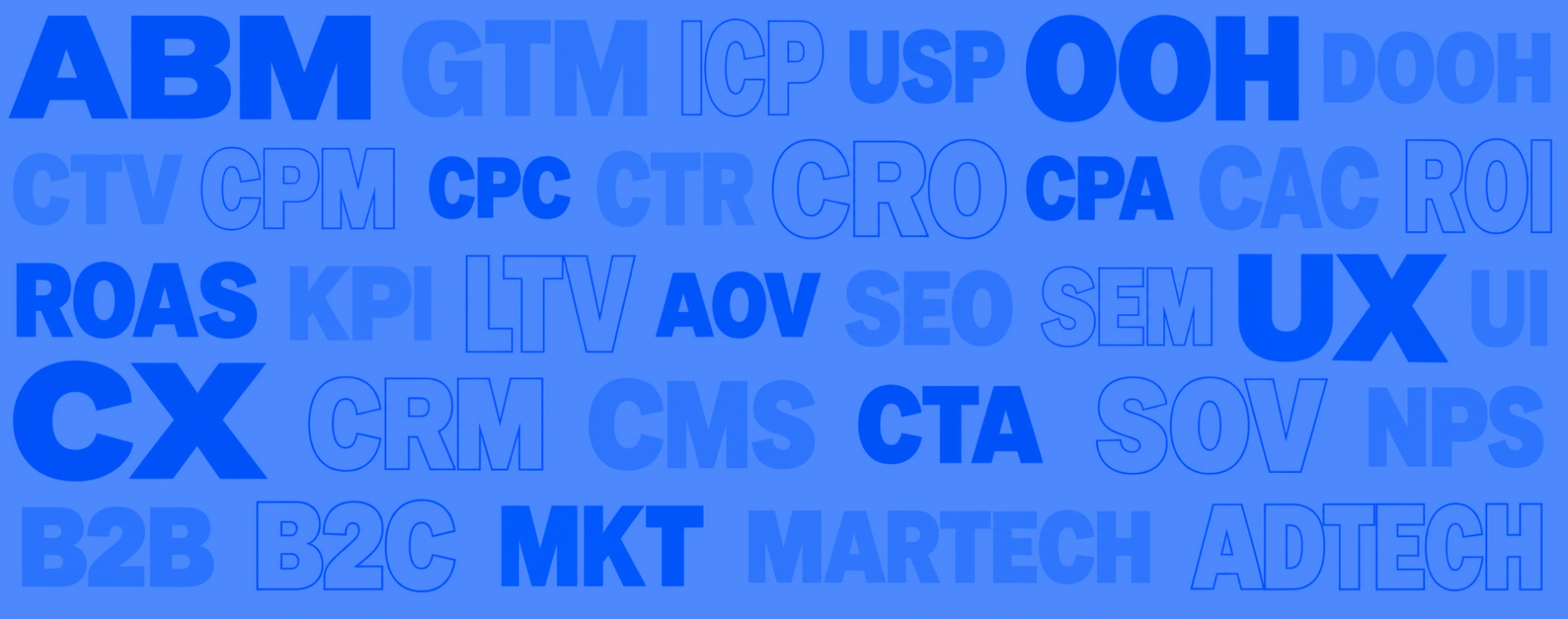
ABM. OOH. GTM. CRO. CX.
For designers who haven’t worked closely with marketing teams, these terms may sound like an entirely different discipline. But many are already contributing to the initiatives they describe.
Throughout my career, I’ve worked at the intersection of brand strategy, creative direction, and marketing. I’ve come to appreciate how much creative thinking contributes to business objectives, often in ways that aren’t immediately visible in the finished work.
I’ve also observed how differently those contributions are described. Marketing teams discuss acquisition, engagement, and conversion, while creative teams discuss concepts, messaging, visual hierarchy, and experience. They’re often working toward the same objectives, using different language.
Understanding both perspectives has reinforced just how connected these disciplines are.
And for designers, recognizing that connection can change how they approach their work, participate in strategic conversations, and communicate their professional value.
Connecting Creative Work to Marketing Objectives
Consider a designer developing digital advertisements, landing pages, and supporting campaign materials.
They’re making decisions about visual hierarchy, messaging, consistency, and how audiences experience information across formats.
From a creative perspective, they’re designing a campaign.
From a marketing perspective, that work may support customer acquisition, conversion optimization, brand awareness, or an account-based marketing initiative.
The terminology changes depending on who’s describing the work, but the designer’s contribution remains essential.
Understanding the business objectives behind a project provides greater context for creative decisions and a shared language for collaborating with marketing leaders, strategists, product teams, and other stakeholders.
It also creates opportunities to contribute more.
You’re Probably Doing More Than You Realize
Marketing encompasses many disciplines, each with its own terminology, objectives, and measures of success. Here are several common examples and how they connect to the work designers already do.
ABM: Account-Based Marketing
ABM focuses on engaging specific, high-value business accounts through targeted messaging and experiences.
Designers contribute by developing personalized campaign assets, presentations, digital experiences, and communications tailored to particular audiences.
The creative challenge involves understanding who the audience is, what matters to them, and how to communicate a relevant message effectively.
Sound familiar?
That’s design thinking applied to a targeted marketing strategy.
OOH: Out-of-Home Advertising
OOH reaches people outside their homes through billboards, transit advertising, and other public displays.
Designers working in this space understand the importance of immediate recognition, visual simplicity, scale, and environmental context.
A billboard may have only seconds to communicate its message. Decisions about typography, contrast, imagery, and composition influence how effectively that message is seen and understood.
GTM: Go-to-Market
A go-to-market strategy outlines how a business introduces a product or service to its intended audience.
Designers bring that strategy to life through brand identity, launch campaigns, websites, product communications, sales materials, and other customer-facing experiences.
Their work helps establish how an offering is presented, understood, and differentiated. Creative thinking can also reveal gaps in the strategy, particularly when the intended message doesn’t translate clearly into the customer experience.
CRO: Conversion Rate Optimization
CRO focuses on improving the percentage of people who complete a desired action, such as making a purchase, registering for a service, or submitting an inquiry.
Designers contribute through information hierarchy, page structure, calls to action, usability, and the clarity of the overall experience.
Thoughtful layouts make information easier to understand. Clear interaction design can reduce friction and help people make informed decisions.
These familiar design considerations have measurable implications for marketing performance.
CX: Customer Experience
CX describes the overall experience people have with a business across their interactions with it.
Designers influence these experiences through websites, applications, communications, packaging, service environments, and other touchpoints.
Consistency, accessibility, clarity, and emotional relevance contribute to how people perceive and interact with a brand.
These examples represent only a portion of marketing terminology, but they demonstrate something important.
Creative professionals are already applying skills that support business objectives across multiple marketing disciplines.
Understanding the Language Expands the Conversation
Knowing what an acronym means is useful. Understanding the strategy behind it is far more valuable.
When a marketing leader discusses improving conversion rates, a designer familiar with CRO can contribute ideas about usability, information hierarchy, visual clarity, and user behavior.
When a team plans an ABM campaign, a designer can ask how the creative experience should differ across target accounts or decision-makers.
When a business prepares to launch a product, designers can contribute to discussions about positioning, differentiation, messaging, and how the offering will be experienced.
These conversations benefit from creative expertise.
Designers bring a distinct perspective to business challenges. They recognize relationships between information, behavior, communication, and experience. They can visualize possibilities, identify inconsistencies, and translate complex ideas into something people can understand.
Marketing fluency helps them apply that expertise within a broader business context.
It also helps them ask better questions.
What is this campaign intended to accomplish?
Who are we trying to reach?
What action do we want people to take?
How will success be measured?
What role does the creative experience play?
These questions connect creative decisions to strategic intent and reinforce the designer’s role in shaping the work’s direction and effectiveness.
Learning to Articulate Your Value
One of the most useful outcomes of understanding marketing is the ability to describe creative contributions more completely.
Designers often discuss their work in terms of deliverables. They designed a website. Developed campaign assets. Created a visual identity. Produced advertisements. These descriptions are accurate, but they don’t always communicate the thinking involved or the objectives the work was intended to support.
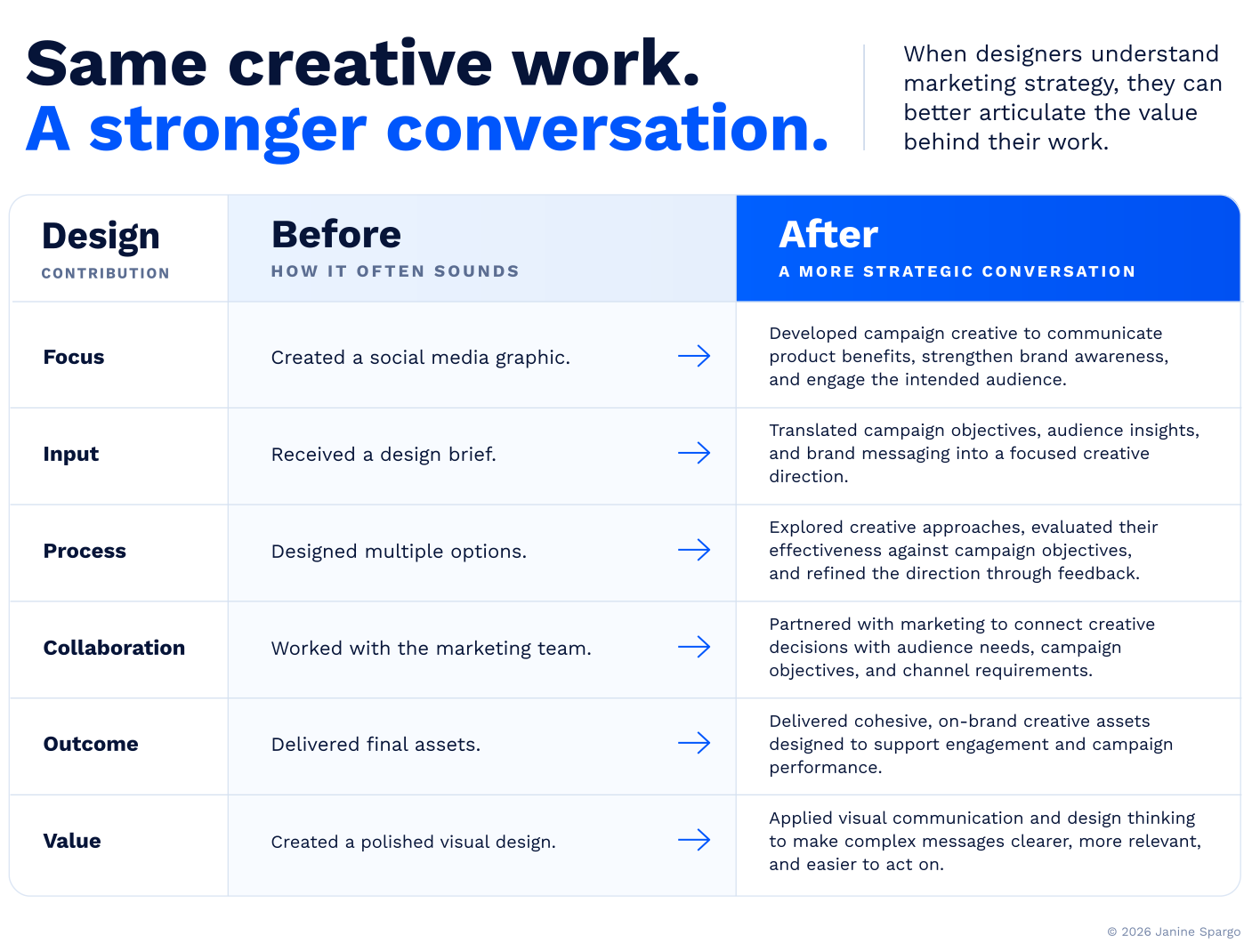
The work hasn’t changed.
This distinction matters in portfolio presentations, interviews, performance reviews, client conversations, and discussions about career advancement.
When performance data is available, understanding relevant metrics also helps designers evaluate what worked, identify opportunities for improvement, and discuss results with greater confidence.
Marketing performance is influenced by many factors, and design is often one part of a larger effort. Creative professionals should be careful not to claim outcomes they cannot substantiate.
But they can confidently explain the objectives their work supported, the decisions they made, and the reasoning behind them.
Their value doesn’t begin when they learn to describe it. Greater fluency simply makes that value easier to communicate.
Your Perspective Belongs in the Conversation
Designers don’t need to become marketing specialists to contribute meaningfully to marketing strategy.
Their expertise is valuable because they approach challenges through a creative lens.
Design thinking brings attention to human needs, communication, usability, relationships, and the ways people experience information. These considerations are fundamental to effective marketing.
The opportunity is to become more familiar with the language, objectives, and business considerations surrounding creative assignments.
Read the campaign brief with curiosity. Ask about the audience and desired outcomes. Learn how marketing teams evaluate performance. Explore unfamiliar terminology that appears in meetings, presentations, and project discussions.
When possible, participate in conversations before creative direction has been established.
Understanding the broader context strengthens the work and expands the designer’s ability to influence it.
The Language of Your Own Value
Creative professionals play an important role in how businesses communicate, differentiate themselves, and connect with people.
Their work shapes perceptions, supports marketing initiatives, improves experiences, and helps turn business objectives into meaningful interactions.
Understanding marketing terminology provides another way to recognize those contributions. It connects the familiar practice of design to the strategies, disciplines, and outcomes surrounding it.
More importantly, it gives designers the language to participate more fully in conversations about the work they do and the value they create.
So the next time you encounter an unfamiliar marketing term, explore what it means, what it’s intended to accomplish, and how design contributes to it.
You may discover that you’ve been part of that conversation all along.
Your creative expertise already belongs in the business conversation. Understanding the language gives you more ways to contribute.
Want to build a stronger connection between brand strategy and creative execution? EpiphanySuite helps you develop the brand foundation behind your creative decisions. Start for free.